Furnishing a luxury villa in Dubai demands strategic budget allocation that balances aesthetic ambition with financial pragmatism. Whether you’re completing a villa design Dubai project in Emirates Hills or Arabian Ranches, understanding Italian furniture investment parameters prevents both under-furnishing that compromises livability and over-capitalization that erodes property value. The Dubai luxury furniture market operates within a AED 150,000 to AED 5,000,000+ spectrum for complete villa furnishing packages, with Italian collections commanding 30-60% premium over comparable mass-market alternatives.
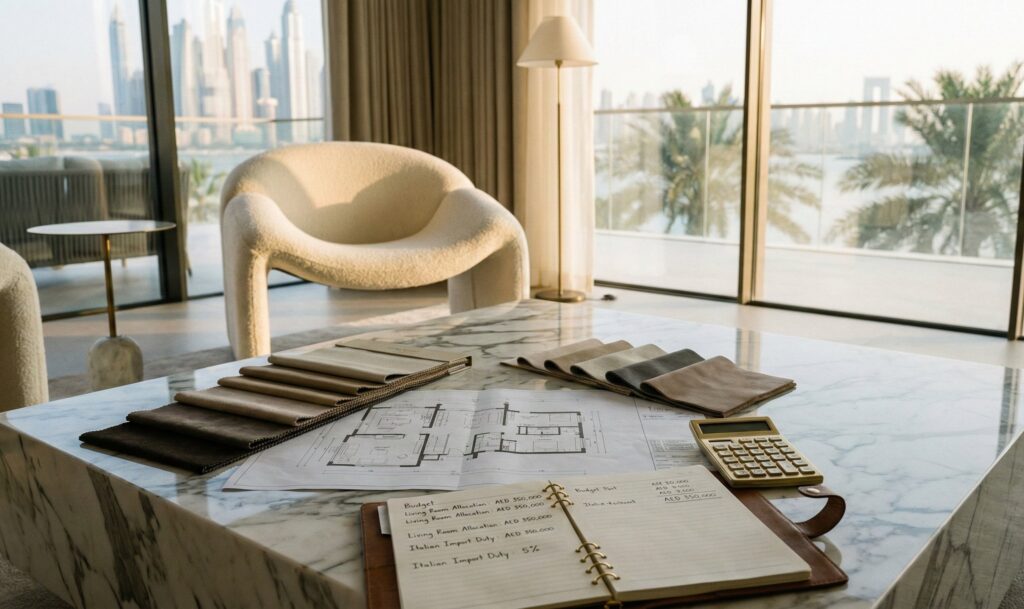
Industry Benchmarks: Furniture Budget as Percentage of Property Value
Financial advisors and interior designers in the UAE luxury sector converge on a 10-15% furniture allocation rule for owner-occupied villas, though this percentage fluctuates based on property tier. A AED 8,000,000 villa in Dubai Hills Estate typically warrants AED 800,000-1,200,000 in furniture and fixtures, while ultra-luxury properties exceeding AED 20,000,000 often allocate 7-10% due to economies of scale and existing architectural features that reduce furnishing density requirements.
Investment properties follow compressed ratios. Rental villas targeting corporate expatriate tenants operate within 5-8% allocation, prioritizing durability and tenant appeal over bespoke craftsmanship. A AED 6,000,000 rental property in Dubai Marina might justify AED 300,000-480,000 in furnishings, emphasizing Italian dining sets and living room anchor pieces while economizing on bedroom collections.
| Property Value (AED) | Owner-Occupied Budget (10-15%) | Rental Property Budget (5-8%) |
|---|---|---|
| 4,000,000 | 400,000 – 600,000 | 200,000 – 320,000 |
| 8,000,000 | 800,000 – 1,200,000 | 400,000 – 640,000 |
| 15,000,000 | 1,500,000 – 2,250,000 | 750,000 – 1,200,000 |
| 25,000,000 | 1,750,000 – 2,500,000 | 1,250,000 – 2,000,000 |
Room-by-Room Budget Allocation Framework for 4-6 Bedroom Villas
Proportional distribution across villa zones maximizes aesthetic coherence while respecting functional hierarchies. Living and entertaining spaces command 40-45% of total furniture budgets, bedrooms absorb 25-30%, dining areas require 12-18%, and home offices, family rooms, and ancillary spaces split the remaining 12-20%. A AED 1,000,000 Italian furniture budget for a 5-bedroom villa in The Meadows would allocate approximately:
- Main living room: AED 280,000-320,000 (sectional sofa, armchairs, coffee tables, side tables, console, lighting)
- Formal dining room: AED 150,000-180,000 (dining table, 10-12 chairs, buffet, display cabinet)
- Master bedroom suite: AED 120,000-150,000 (bed, nightstands, dresser, seating area, walk-in closet system)
- Secondary bedrooms (4x): AED 200,000-240,000 total (beds, storage, desks, seating)
- Family/informal living: AED 80,000-100,000 (sectional, media console, occasional furniture)
- Home office: AED 60,000-80,000 (executive desk, chairs, bookcases, meeting table)
- Outdoor terrace: AED 70,000-90,000 (weather-resistant Italian collections, though often non-Italian)
- Foyer and circulation: AED 40,000-60,000 (console tables, mirrors, seating benches)
This distribution reflects Dubai’s entertaining culture, where receiving guests elevates living and dining zones above private bedroom investments. European expatriates often invert this pattern, allocating 35% to living areas and 35% to bedrooms, reflecting different lifestyle priorities.
Strategic Investment: Where to Spend More Within Italian Collections
Italian furniture spans quality tiers from industrial-grade luxury (brands like B&B Italia, Poliform, Minotti) to accessible contemporary (Calligaris, Natuzzi, Bonaldo). Discerning buyers concentrate budgets on high-visibility, high-use items while economizing on lower-impact pieces. Premium investment priorities include:
Main sectional sofa: Daily use justifies AED 80,000-180,000 for top-tier Italian leather or performance fabrics with engineered frames. A Minotti Andersen or B&B Italia Charles sofa delivers 15-20 year service life with proper maintenance, versus 5-7 years for mid-market alternatives. Cost-per-use calculations favor premium investment here.
Dining table: Centerpiece status and engineered wood stability warrant AED 45,000-90,000 for brands like Cattelan Italia or Bonaldo. Extendable mechanisms, lacquered finishes, and marble inlays justify premium positioning. Chairs, conversely, can blend premium host chairs (AED 3,500-6,000 each) with more accessible side chairs (AED 1,800-2,800 each).
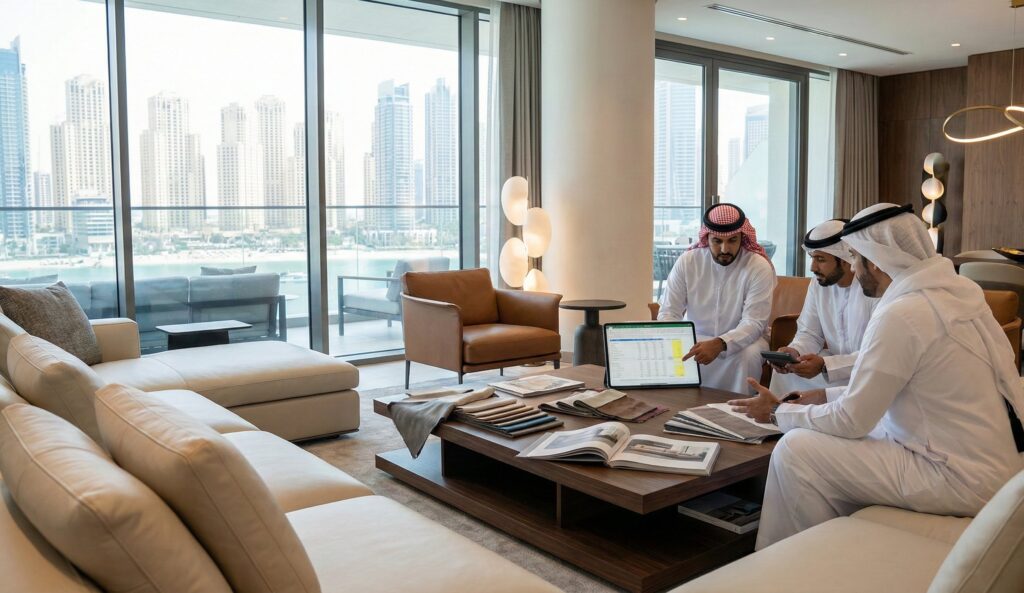
Master bed: Eight hours of daily use supports AED 35,000-65,000 investment in Italian engineered bed frames with integrated storage, upholstered headboards, and premium slatted bases. Brands like Flou and Alf DaFrè deliver superior ergonomics and longevity.
Economization opportunities emerge in lower-visibility zones. Secondary bedroom furniture, home office storage, and circulation area pieces can source from Italian mid-market brands (Calligaris, Tomasella, SMA) at 40-60% cost reduction without perceptible quality sacrifice. Guest bedroom furniture rarely justifies ultra-premium investment given infrequent use patterns.
Entry-Level Italian Furniture: Quality at Accessible Price Points
Contemporary Italian manufacturers produce design-forward collections targeting AED 5,000-15,000 per major piece, expanding Italian furniture accessibility beyond ultra-luxury brackets. Brands like Calligaris, Bontempi, and Bonaldo offer dining tables (AED 8,000-18,000), sectional sofas (AED 22,000-45,000), and bedroom sets (AED 25,000-50,000 for complete suites) with authentic Italian design DNA.
Quality indicators at this tier include solid wood frames, Italian-milled veneers, European hardware, and certified foam densities (35kg/m³+ for seating). A 6-seat Calligaris extendable table at AED 12,000 delivers comparable functionality to AED 40,000+ luxury alternatives, though finishing nuances and exotic materials differ. For budget-conscious villa furnishing, these collections allow Italian design language throughout while preserving capital for anchor investments.
Solomia Home’s accessible Italian collections demonstrate this segment’s viability, offering complete living room packages (sofa, armchairs, coffee table, side tables, console) starting at AED 65,000-85,000 using brands like Dall’Agnese and Tomasella. This positions Italian furniture within reach of AED 4,000,000-6,000,000 villa owners previously limited to mass-market alternatives.
The Anchor Piece Strategy: Statement Investments with Complementary Selections
Experienced interior designers employ anchor piece methodology to maximize perceived luxury while managing budgets. Each primary space receives one premium Italian investment piece (AED 40,000-120,000) surrounded by complementary mid-tier selections. This creates visual hierarchy and focal points without requiring uniform ultra-premium density.
Living room example: A AED 95,000 Minotti sectional serves as anchor, complemented by AED 8,500 Bontempi side tables, AED 12,000 Cattelan Italia coffee table, and AED 18,000 Calligaris console. Total investment: AED 133,500 versus AED 220,000+ for full premium-tier furnishing, while maintaining luxury perception.
Dining room application: A AED 65,000 Cattelan Italia marble dining table anchors the space, paired with AED 2,800 Bontempi chairs (10x = AED 28,000) and AED 22,000 Dall’Agnese buffet. Total: AED 115,000 versus AED 185,000+ for uniform premium selection.
This strategy particularly benefits rental properties where tenant perception centers on hero pieces rather than comprehensive luxury. Strategic anchor investments in living room sofas, dining tables, and master beds create premium positioning at 35-45% cost reduction.
Phased Furnishing Approach: Prioritizing Spaces Over Time
Cash flow constraints and occupancy timelines often necessitate staged furniture procurement. Financial planners recommend three-phase implementation that balances livability with budget management:
Phase 1 (Immediate occupancy – 60% of budget): Living room, dining room, master bedroom, kitchen eating area, one guest bedroom. This phase establishes core functionality and entertaining capability within 4-6 weeks of villa handover. Budget allocation: AED 600,000 of AED 1,000,000 total.
Phase 2 (Months 3-6 – 25% of budget): Secondary bedrooms, home office, family room, outdoor dining. This expansion accommodates extended family visits and work-from-home requirements. Budget allocation: AED 250,000.
Phase 3 (Months 9-12 – 15% of budget): Refinement pieces, art procurement, textile upgrades, supplementary storage. This phase elevates completed spaces and addresses usage-revealed needs. Budget allocation: AED 150,000.
Phased approaches offer financial advantages beyond cash flow management. Occupancy experience reveals lifestyle patterns that inform subsequent purchases, reducing misaligned acquisitions. A family discovering extensive terrace usage during cooler months can reallocate Phase 2 funds toward premium outdoor furniture rather than initially planned office upgrades.
Hidden Costs: Delivery, Installation, Import Duties, and Assembly
Published furniture prices represent 70-85% of total acquisition costs in Dubai’s import-dependent market. Comprehensive budget planning incorporates ancillary expenses that can add AED 80,000-200,000 to a AED 800,000 furniture package:
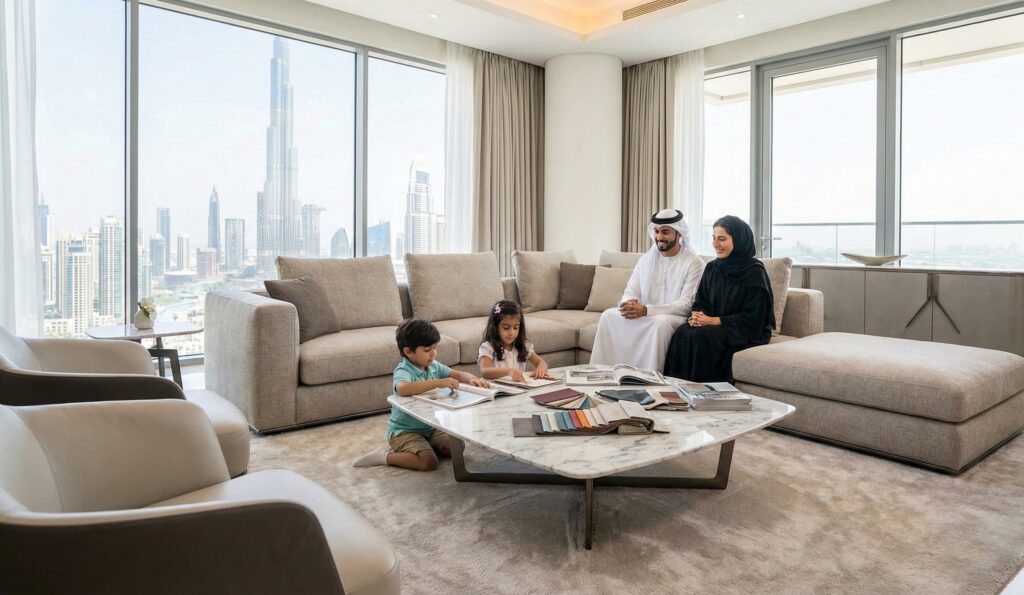
Import duties and customs clearance: UAE customs levy 5% duty on furniture imports, calculated on CIF (Cost, Insurance, Freight) value. A AED 500,000 Italian furniture container incurs approximately AED 25,000-28,000 in duties and clearance fees. U.S. Department of Commerce data confirms these standardized rates across GCC markets.
Freight and logistics: Container shipping from Italy to Jebel Ali Port costs AED 15,000-28,000 depending on volume (20ft vs 40ft containers) and seasonal demand. Last-mile delivery to villa locations adds AED 3,500-8,000 based on emirate and access complexity. Palm Jumeirah and gated community deliveries incur premium charges.
Professional assembly and installation: Italian furniture often requires specialized installation, particularly integrated wall systems, modular sofas, and extendable dining mechanisms. Professional assembly costs AED 80-150 per hour with typical full-villa installation requiring 40-60 labor hours. Budget AED 8,000-15,000 for complete installation services.
White glove services: Premium furniture retailers offer comprehensive logistics including customs clearance, warehousing, scheduled delivery, installation, packaging removal, and post-installation adjustments. These turnkey services add 12-18% to furniture costs but eliminate coordination burdens. For a AED 800,000 purchase, white glove premium totals AED 96,000-144,000.
| Cost Component | Percentage of Furniture Value | Example (AED 800,000 purchase) |
|---|---|---|
| Import duties (5%) | 5% | 40,000 |
| Freight and delivery | 3-5% | 24,000 – 40,000 |
| Assembly and installation | 1-2% | 8,000 – 16,000 |
| Packaging removal/disposal | 0.5% | 4,000 |
| Insurance and contingency | 1-2% | 8,000 – 16,000 |
| Total ancillary costs | 10.5-14.5% | 84,000 – 116,000 |
Interior Designer Fees and FF&E Procurement Costs
Professional interior design services in Dubai operate under three primary compensation models, each impacting total furniture budgets differently. Understanding these structures prevents budget surprises during project execution.
Fixed fee design: Designers charge AED 150-400 per square meter for complete interior design services including space planning, material selection, furniture specification, and procurement coordination. A 5,000 square foot (465 m²) villa incurs AED 70,000-186,000 in design fees. This model provides cost certainty but separates design compensation from furniture purchasing.
Percentage of furniture and fixtures (FF&E): Common in luxury residential projects, designers receive 20-30% commission on furniture, lighting, and accessories procurement. A AED 1,000,000 FF&E budget includes AED 200,000-300,000 in designer compensation. This model aligns designer motivation with premium selections but can inflate budgets if unchecked. Reputable designers like those at Solomia Home maintain transparency by presenting gross and net costs separately.
Hybrid fixed plus procurement fee: Combines base design fee (AED 100-200/m²) with reduced procurement commission (10-15%). This balances cost predictability with procurement incentive alignment. A 465 m² villa might incur AED 46,500-93,000 base fee plus 10-15% on AED 1,000,000 furniture (AED 100,000-150,000), totaling AED 146,500-243,000.
FF&E procurement extends beyond furniture to include lighting fixtures (10-15% of furniture budget), window treatments (5-8%), accessories and art (8-12%), and custom millwork (15-25%). A comprehensive AED 1,000,000 allocation distributes approximately: furniture AED 650,000-700,000, lighting AED 100,000-120,000, window treatments AED 60,000-80,000, accessories AED 80,000-100,000, millwork AED 110,000-170,000.
Full Italian Furnishing Versus Mixed-Origin Strategies
Dogmatic adherence to single-origin furnishing limits design flexibility and inflates costs without proportional value addition. Contemporary luxury interiors increasingly embrace curated eclecticism, combining Italian statement pieces with complementary furniture from other design centers.
100% Italian approach: Provides aesthetic consistency and simplified procurement but commands 35-50% premium versus mixed strategies. A AED 1,200,000 all-Italian package might achieve equivalent design impact at AED 780,000-900,000 through selective integration of German kitchen systems (Bulthaup, Poggenpohl), Scandinavian lighting (Louis Poulsen, &tradition), and American performance upholstery (Restoration Hardware outdoor collections).
Italian core with strategic supplements: Recommended approach concentrates Italian procurement in visible, high-impact zones (living, dining, master bedroom) while sourcing secondary spaces from design-compatible alternatives. Budget breakdown for AED 1,000,000 total:
- Italian furniture (60-70%): AED 600,000-700,000 for living, dining, master suite
- European non-Italian (15-20%): AED 150,000-200,000 for kitchen, office, storage systems
- Global contemporary (10-15%): AED 100,000-150,000 for outdoor, children’s rooms, service areas
- Custom local fabrication (5-10%): AED 50,000-100,000 for built-ins, upholstery
This strategy optimizes design cohesion and budget efficiency. Italian dining tables pair effectively with Danish modern lighting and American task seating in home offices. The key lies in maintaining stylistic consistency (contemporary, transitional, or classical) rather than origin homogeneity.
Rental Villa Furnishing Budgets for Investor Properties
Investment properties require fundamentally different furniture strategy than owner-occupied villas. Tenant turnover, wear acceleration, and maintenance costs shift priorities toward durability, replaceability, and tenant appeal rather than bespoke luxury.
Dubai’s corporate rental market (3-year average tenancy) supports Italian furniture investment in high-visibility areas that influence leasing velocity and achievable rents. Market data from Dubai real estate analytics indicates premium-furnished villas command 15-25% rental premiums, justifying strategic furniture investment.
Optimal rental property allocation (5-8% of property value):
- Living room (35% of furniture budget): Durable Italian or Italian-style leather sectionals, performance fabric upholstery, cleanable surfaces. Brands like Natuzzi and Nicoletti offer commercial-grade residential collections. Budget: AED 105,000-140,000 of AED 400,000 total.
- Dining room (20%): Scratch-resistant lacquered or tempered glass tables, wipeable chair upholstery, conventional (non-luxury) hardware. Budget: AED 80,000.
- Master bedroom (15%): Quality Italian bed frames with replaceable upholstery, hotel-grade mattresses (replaced every 5-7 years), standard storage. Budget: AED 60,000.
- Secondary bedrooms (20%): Modular furniture allowing easy replacement, non-Italian alternatives acceptable here. Budget: AED 80,000.
- Outdoor (10%): Weather-resistant materials, replaceable cushions, theft-deterrent designs. Budget: AED 40,000.
Maintenance reserves of 8-12% annual furniture budget cover upholstery cleaning, hardware repairs, and progressive replacement. A AED 400,000 furnished rental villa requires AED 32,000-48,000 annual maintenance allocation to preserve asset condition and tenant satisfaction.
Case Study Budgets: Furnishing Dubai Hills Villa at Three Price Tiers
Practical budget application to a representative Dubai villa—5-bedroom, 6,200 square feet (576 m²), valued at AED 9,500,000—demonstrates allocation methodologies across conservative, moderate, and premium approaches.
Conservative Approach: AED 650,000 (6.8% of property value)
Emphasizes mixed-origin strategy with Italian anchor pieces, suitable for budget-conscious owners or rental investors.
- Living room: AED 180,000 (Italian Natuzzi sectional, Bontempi tables, mixed lighting)
- Dining room: AED 110,000 (Cattelan Italia table, Calligaris chairs, local buffet)
- Master bedroom: AED 85,000 (Italian Alf DaFrè bed, IKEA PAX closets, mixed storage)
- Secondary bedrooms (4x): AED 140,000 total (mixed Italian entry-level and non-Italian)
- Family room: AED 45,000 (performance fabric sectional, media storage)
- Home office: AED 35,000 (mixed contemporary furniture)
- Outdoor: AED 30,000 (non-Italian weather-resistant)
- Ancillary/circulation: AED 25,000
Outcome: Functional, attractive villa with strategic Italian presence in entertaining spaces. Suitable for rental properties or owners prioritizing other investments.
Moderate Approach: AED 1,150,000 (12.1% of property value)
Balanced Italian procurement across major zones with quality selections throughout, representing industry-standard allocation for owner-occupied luxury villas.
- Living room: AED 350,000 (Minotti or Flexform sectional, Cattelan tables, premium lighting)
- Dining room: AED 185,000 (Bonaldo marble table, Calligaris premium chairs, Italian buffet)
- Master bedroom: AED 165,000 (Flou bed and nightstands, Rimadesio closet system, seating area)
- Secondary bedrooms (4x): AED 260,000 total (consistent Italian mid-tier brands)
- Family room: AED 85,000 (Italian sectional, integrated media)
- Home office: AED 70,000 (Poliform or Alf DaFrè office system)
- Outdoor: AED 55,000 (premium weather-resistant, mixed origin)
- Ancillary/circulation: AED 50,000
Outcome: Cohesive Italian design language throughout major spaces, appropriate for discerning owners expecting 10+ year occupancy. Represents Solomia Home’s typical client demographic.
Premium Approach: AED 1,900,000 (20% of property value)
Comprehensive ultra-luxury Italian furnishing with top-tier brands, custom pieces, and designer collaboration. Exceeds standard benchmarks for statement properties or design enthusiasts.
- Living room: AED 580,000 (B&B Italia or Poliform Varenna modular seating, designer tables, architectural lighting)
- Dining room: AED 320,000 (Luxury Italian marble table, designer chairs, integrated wine storage)
- Master bedroom: AED 280,000 (Custom Italian bed system, Rimadesio walk-in, luxury seating suite)
- Secondary bedrooms (4x): AED 420,000 total (premium Italian throughout including children’s specialty furniture)
- Family room: AED 150,000 (integrated AV Italian cabinetry, performance luxury seating)
- Home office: AED 130,000 (executive Italian system with integrated technology)
- Outdoor: AED 90,000 (luxury weather-resistant with Italian design elements)
- Ancillary/circulation: AED 80,000 (designer console tables, custom mirrors, art pedestals)
Outcome: Museum-quality residential interiors suitable for design publication, executive entertaining, or ultra-luxury positioning. Represents top 5% of Dubai villa furnishing projects.
Implementation Recommendations for Budget Optimization
Successful villa furnishing within budget parameters requires disciplined procurement methodology and realistic timeline expectations. Industry best practices include:
Pre-design budget allocation: Establish firm furniture budget before design development begins, allocating contingency (10-15%) for scope expansion or specification upgrades. This prevents aspirational designs exceeding financial capacity.
Prioritized specification: Develop A/B/C specification tiers during design phase. “A” items (must-have premium investments) receive full budget allocation, “B” items (important but flexible) allow brand substitution, “C” items (nice-to-have) defer to subsequent phases if budget pressure emerges.
Consolidated procurement: Bundle furniture orders to maximize shipping efficiency and negotiate volume discounts. Single-container consolidation (typically 35-45 furniture pieces) reduces per-unit logistics costs by 20-30% versus multiple partial shipments.
Seasonal timing: Italian furniture factories operate on annual collection cycles with model year transitions in January and July. End-of-cycle procurement (December, June) accesses outgoing inventory at 25-40% discounts without quality compromise. Planning villa handover to align with these cycles yields significant savings.
Showroom floor models: Established retailers like Solomia Home periodically refresh display inventory, offering floor models at 30-50% reductions. These pieces show minimal wear from controlled showroom environments and provide immediate availability versus 12-16 week factory lead times typical for new production.
Dubai’s competitive luxury furniture market rewards informed buyers who balance aesthetic vision with financial discipline. Italian furniture investment enhances villa value, livability, and market positioning when executed within rational budget frameworks that prioritize strategic quality over comprehensive excess.